Overview
Welcome to Psychological Rhetorics and Ecology Rhetorics
Psychological Rhetorics
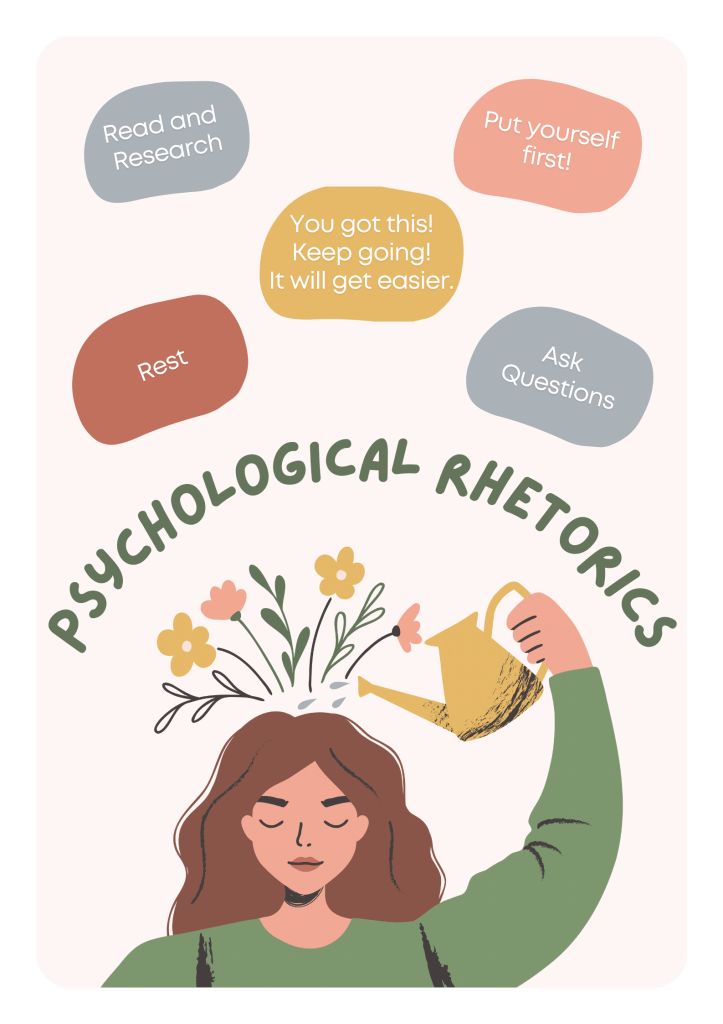
Psychological Rhetorics examines how language and persuasion intersect with psychological theories and behaviors to shape human interactions and understanding. You will explore how rhetorical strategies are employed to influence perception, thought, and action, both consciously and unconsciously. By analyzing the dynamics of persuasion, self-awareness, and interpersonal communication, students will uncover how psychological concepts are embedded in everyday rhetoric. The goal is to cultivate an awareness of how rhetoric and psychology intersect to inform critical thinking, ethical decision-making, and meaningful engagement with others.
Ecology Rhetorics
Ecology Rhetorics investigates the relationship between rhetoric, human perspectives, and the natural world. Through this lens, you will explore how language and argumentation shape ecological narratives, environmental policies, and societal attitudes toward sustainability. This module encourages students to critically analyze the ways rhetorical framing can either support or undermine ecological awareness and advocacy. By engaging with these perspectives, you will develop the tools to articulate informed positions on ecological issues and to advocate effectively for sustainable practices within diverse communities.
Personal Quote: Own your “no” , so that you can protect your “yes”.
Assignment 1
Draw an alien and bring it to the next class. No it cannot be on the computer. No it does not have to be perfect. Yes, I know you are not an artist. Yes, I know this is not art class. It does not matter if it is on lined paper or printer paper, just ensure it is a full sheet of paper and your drawing is the same size. Just draw an alien.
Assignment 2
Use these instructions for your Mbongi research.
Students should be able to summarize the sources they found and detail when it was written and by who. Students should also detail why the source is credible.
Note: You MUST include the following information for all of your sources:
The Author; The Title; and the Year the article was published.
Write it each in this format:
According to [Title], an [article, book, website, etc.] written by [Author(s)], …[claim]…
At the end of the information put the year it was written, in parenthesis.
Example: According to A Study of Georgia Fish, an article written by Dr. J. Wiggins, “This would be a direct sentence from the source” (2021).
Research These
You must find Galileo sources for 3 of these. Save them. You must bring 1 source to class. The one you bring to class should be the one you find most interesting. The one you bring to class must be annotated. The one you bring to class does not have to be from Galileo.
- Greenwashing
- Sankofa
- Kimberlé Crenshaw and intersectionality (write half a page about her, intersectionality, and how it relates to you)
- What social issue bothers you the most? Why?
- Maslows Hierarchy
- Anthropocentrism vs Ethnocentrism
- Id, Ego, Superego
- The Visible Spectrum (what can be seen with the human eye)
- Gaslighting
- Maslow’s Hierarchy used in Nursing
- Being a Critical Thinker vs Being a Contrarian
- Who are you?
- Why can’t farmers replant their own seeds??
Here is a link to Galileo: https://www.galileo.usg.edu/
Watch ALL the Following
YouTube Videos (Click to DROP DOWN)
Readings
Websites (Click to DROP DOWN)
AFROCENTRIC SCHOLARS MUST FIRST “KNOW THYSELF” (18)
by Dr. Joseph A. Bailey II, MD., FACS
https://theievoice.com/afrocentric-scholars-must-first-know-thyself-18/#:~:text=%E2%80%9CMan%2C%20Know%20Thyself%E2%80%9D%20was,pre%2Dbirth%20Cosmic%20Organism%20origin.
Clinical Corner: Maslow’s Hierarchy of Needs and Indigenous Health: https://tribalhealth.com/maslow-hierarchy/#:~:text=But%20I’m%20guessing%20most,his%20theory%20of%20hierarchical%20needs.
The Blackfoot Wisdom that Inspired Maslow’s Hierarchy: https://www.resilience.org/stories/2021-06-18/the-blackfoot-wisdom-that-inspired-maslows-hierarchy/
Short PDFS (Click to DROP DOWN)
Books You May Like
From the Textbook
Thirty-Eight who Saw Murder Didn’t Call the Police by martin Gansberg
The Price of Silence by Laura Bobnak
Shooting an Elephant by George Orwell
Just Walk on By: A Black Man Ponders His Power to Alter Public Space by Brent Staples
The Embalming of Mr. Jones by Jessica Mitford
The Lottery by Shirley Jackson
Photos That Change History by Karen Miller Pensiero
The Ways We Lie by Stephanie Ericsson
Goodness: Altruism and the Literary Imagination by Toni Morrison
National Highway traffic Safety Administration and the Ad Council, You Don’t Want Them Responding to Your Text (Ad)
 Jordan Wiggins